At Alphyn.AI, our specialists have spent many years implementing and adapting a wide range of IT solutions — including MDM systems, both home-grown and from established vendors. Drawing on that accumulated experience, we built our own high-performance, multi-domain product: Alphyn Lakehouse.

In building the MDM component of Alphyn Lakehouse, we studied the market and its needs carefully. In this post, we share the results of that analysis and explore why MDM solutions matter for modern business, what role they play, and what problems they solve — illustrated through the lens of the customer data domain.
Why customer data quality is a business-critical concern
Companies beginning to implement a Know Your Customer (KYC) programme often underestimate how much data quality matters. When the number of data sources inside an organization is still manageable, the common approach is to designate one System of Record (SoR) — for example, an operational CRM — as the authoritative home for customer data.
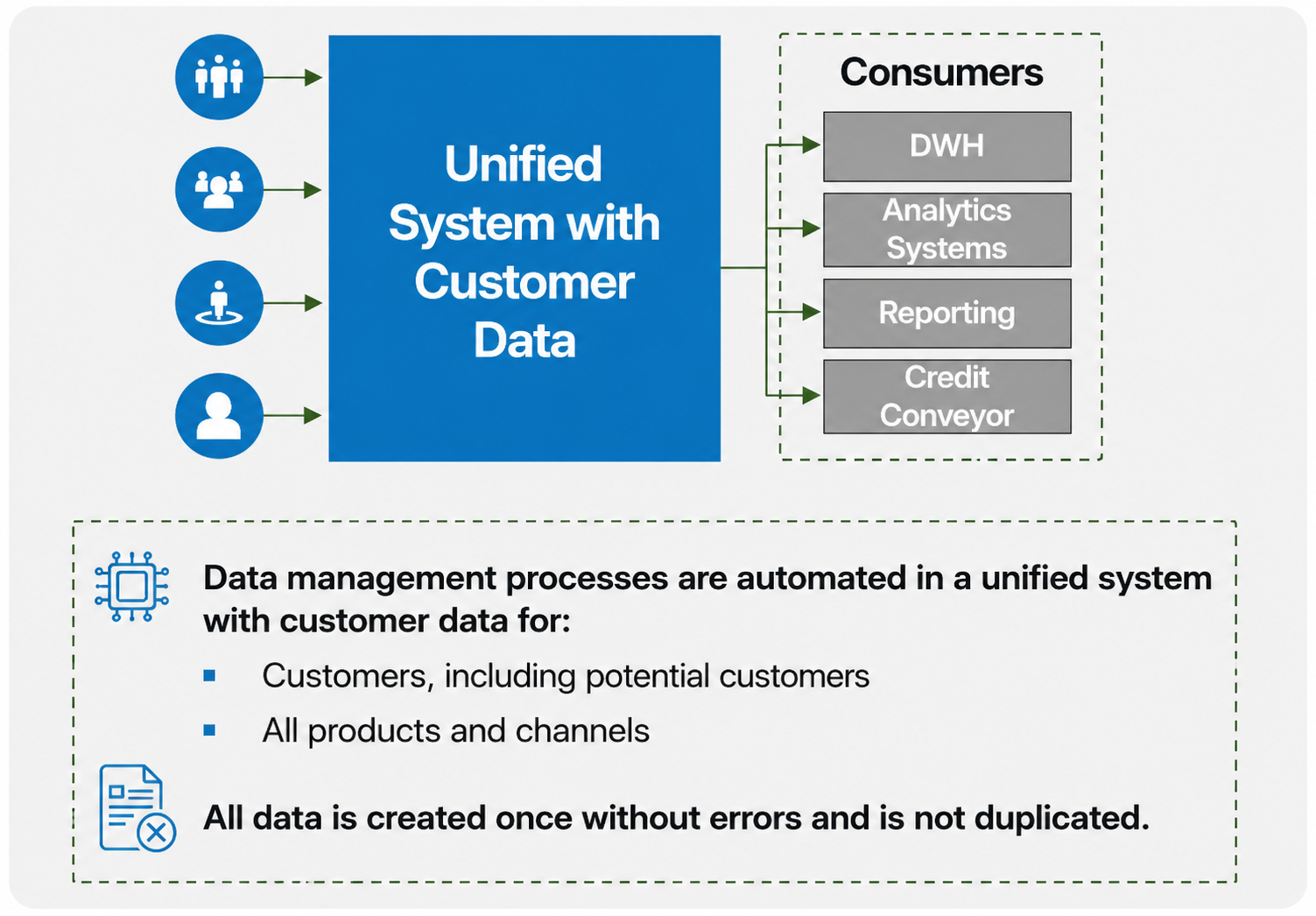
A single entry point for customer data can satisfy the organization's needs for quite a long time. But the approach starts showing its limits as new customer data sources appear, along with enrichment feeds and downstream consumers.
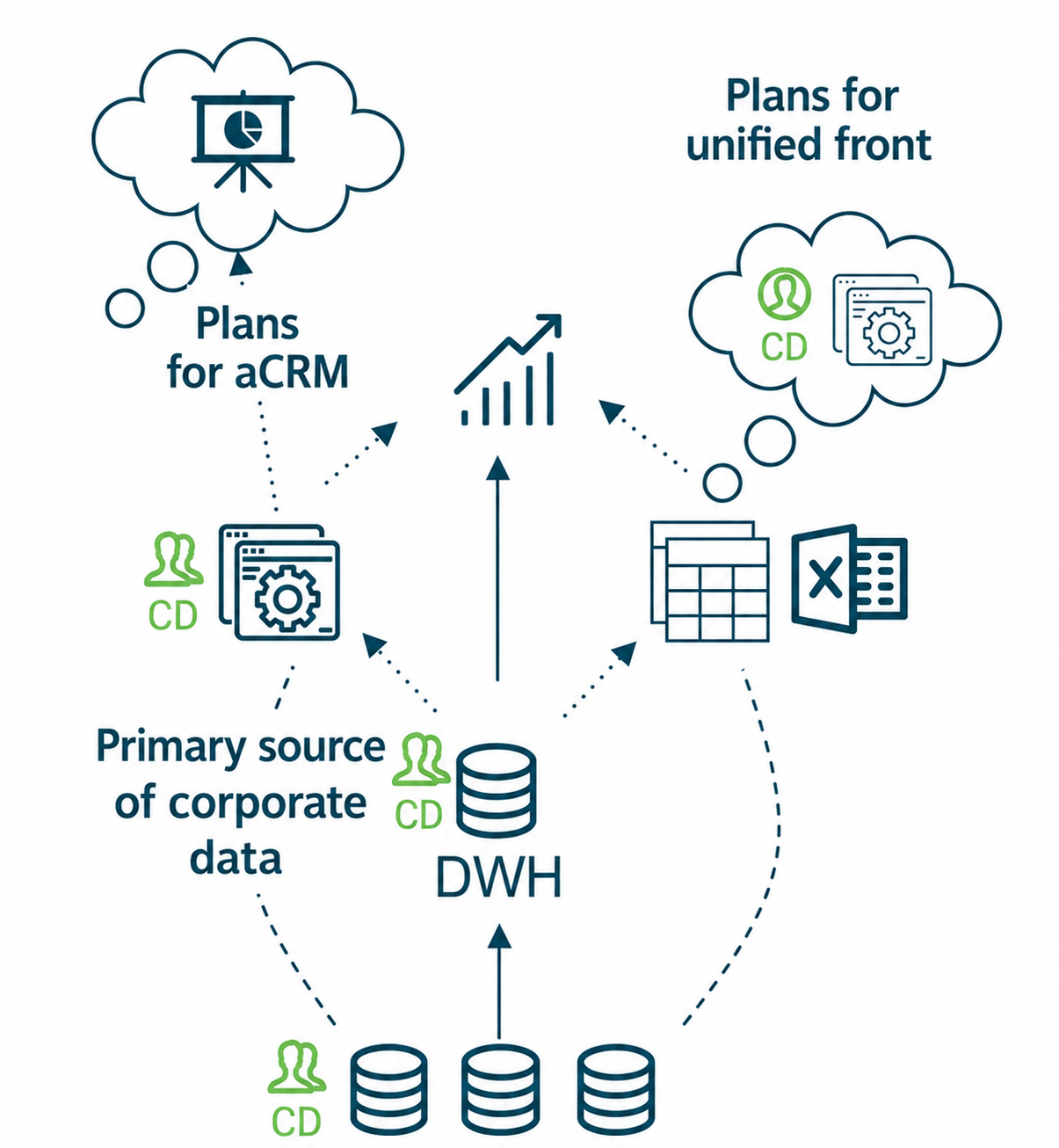
As source systems multiply, customer data replicas proliferate, and enriched datasets pile up, maintaining data quality becomes progressively harder. Business processes around each source system are typically siloed, so quality problems can go unnoticed for a long time and compound quietly. At this point organizations often attempt to restore order by consolidating all customer data into a single mart and writing deduplication scripts on top of it.
Such solutions are a half-measure that tends to stagnate. The right way to address the problem systematically is MDM. The catalyst for that decision is usually a business initiative that is heavily dependent on customer data quality — CVM programmes, AML development, or Data Science projects.
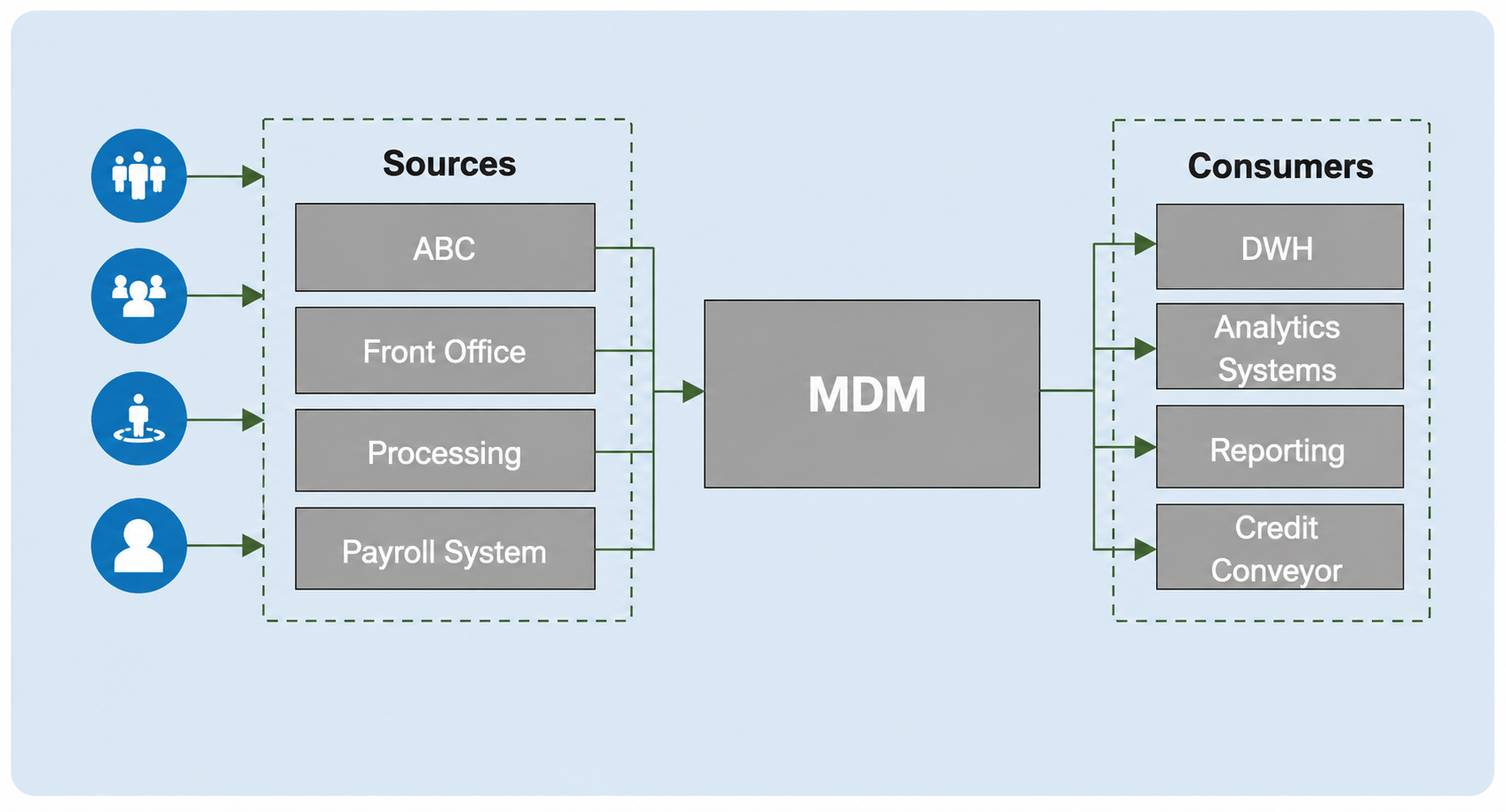
If the data strategy does not account for the necessary organizational changes — people, processes, and governance — and instead bets exclusively on technology, with MDM relegated to a secondary role, even these projects risk running into serious trouble or outright failure.
Build vs. buy: requirements and pitfalls
There are several ways to implement the architecture shown above:
Build from scratch in-house;
Build on top of an existing system in the organization;
Implement a purpose-built MDM product;
The first two approaches carry inherent risks and architectural inflexibility. When building a custom analytical MDM, organizations inevitably run into the most common problems:
There is likely to be no UI. Inspecting system behavior means going straight to the database;
The data model is managed at the database level;
Change-history logging is typically cut from scope to save budget.
The cost of such a solution can easily exceed the original budget by an order of magnitude.
The strategically sounder path is to invest in a professional MDM product — one that delivers the following characteristics:
Automated golden-record formation
Users should be able to participate in the process, but the less manual intervention required, the greater the payoff. This is especially true when source systems hold tens of millions of customer records;Domain-specific business logic, configurable by the customer
It is essential that customers can make changes without involving the vendor. Business requirements evolve constantly. While rules for fixing typos or parsing addresses may change infrequently, classification rules or name-dictionary parsing rules need refinement several times a year. Many products on the market offer business-logic customization, but it is meaningless if building that logic from scratch takes months;An evolvable, extensible data model
Ongoing data-quality work and the onboarding of new sources demand that the data model can change over time. The system must track which schema version each record was written under and provide tooling to upgrade record versions. This matters most when large external data sets are ingested and derived-value fields are added;Horizontal scalability and operational high-performance mode
Deploying MDM is only the first step toward understanding an organization's data. The data strategy roadmap typically calls for preparing real-time consumer integrations several months before the corresponding projects kick off. Initially, running MDM in a resource-intensive operational mode is unnecessary — but after several quality-improvement cycles and as downstream consumer projects go live, that capacity becomes essential.
MDM deployment is the first critical step toward customer data quality
At Alphyn.AI we develop IT products for enterprise data management, including master data management. Our MDM offering — part of the Alphyn Lakehouse platform — is a high-performance solution for cleansing, enriching, standardizing, and deduplicating customer data. It is designed for mid-size and large enterprises building out a "Know Your Customer" capability, and it embodies all the principles described above.
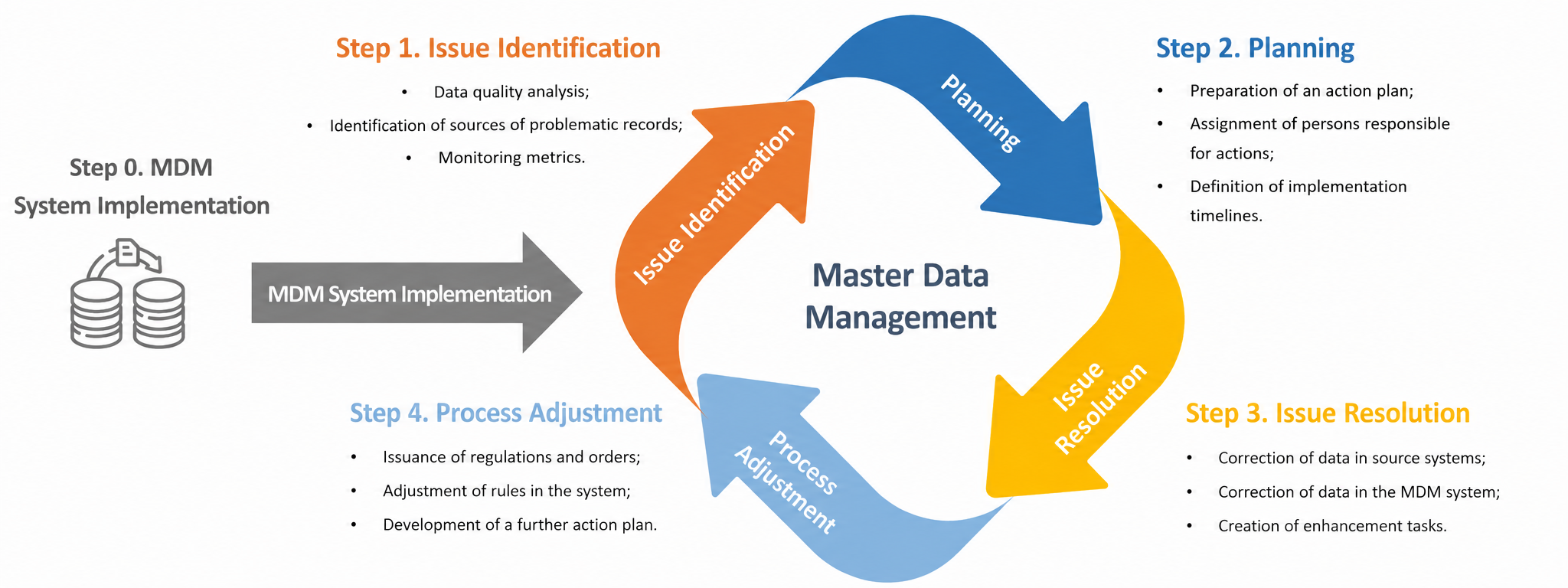
Data quality work cannot be reduced to a one-time system deployment. It is a continuous cycle of investigative and corrective activities aligned to the organization's evolving needs. The system must be flexible and adaptive enough to support that ongoing work.
The MDM component of Alphyn Lakehouse provides several layers of focus for quality improvement teams:
At the base layer are quality codes — the most granular entity, attached to every piece of information flowing through the system. Business-logic rules that fire against a record tag the affected field, group of fields, or entire record with a result code.
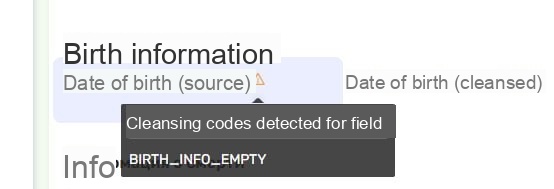
Some codes mark fields that the system corrected automatically; others flag cases where automatic correction is not possible and human attention is required. When a problem corresponding to a code is resolved and the code is no longer valid, it is automatically cleared — but the historical fact that the code was ever set remains permanently in the audit trail for retrospective analysis and statistical review.
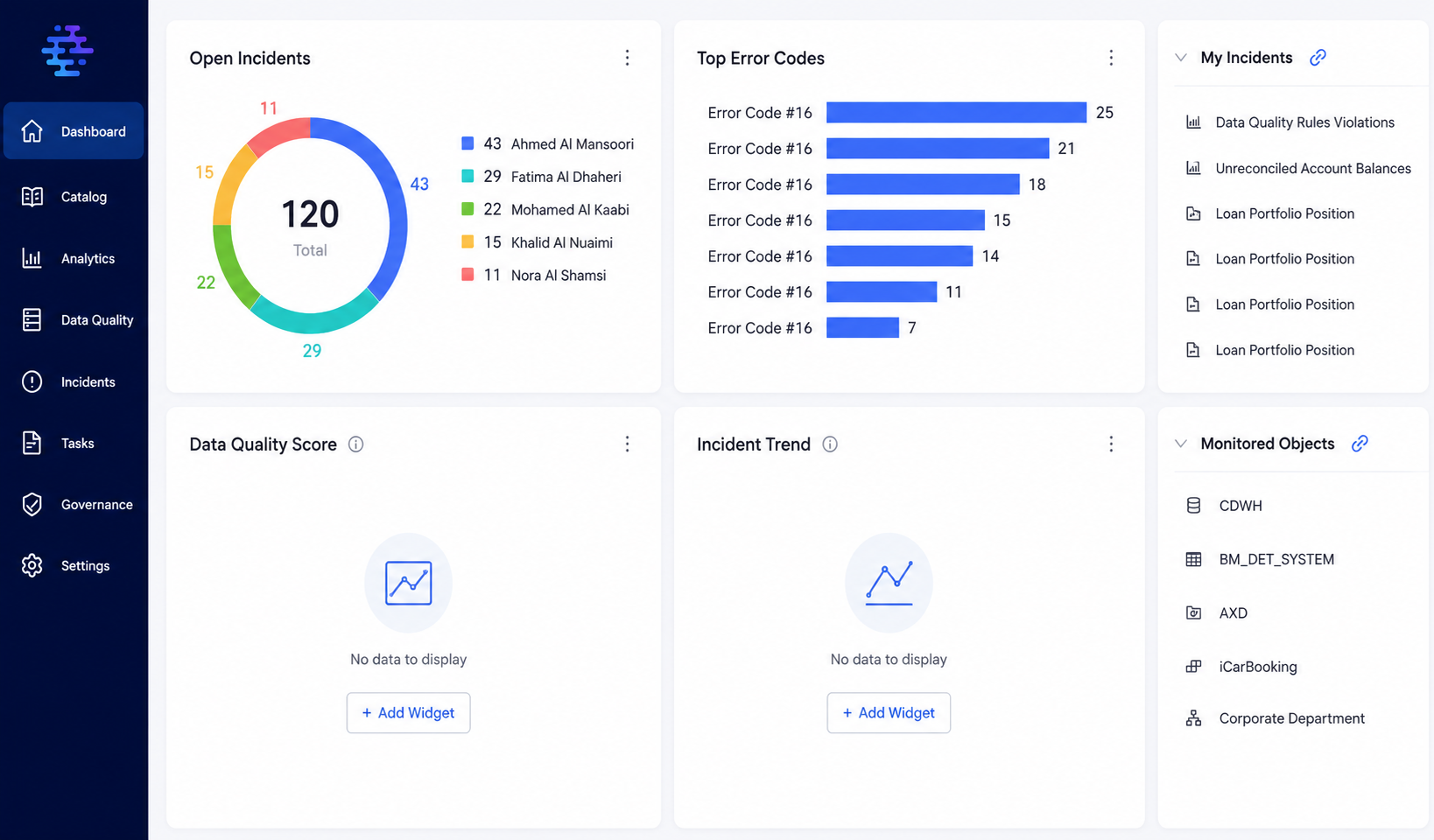
When a particular quality code or group of codes requires dedicated attention, an incident-creation rule is configured. By default, the MDM does not generate an incident for every event the system detects, to avoid overwhelming users. Incidents are created and automatically assigned to responsible parties according to predefined logic. When the root cause of an incident is resolved, it is automatically closed with a timestamp. Each user sees only the incidents assigned to them and can focus on resolving those.
For proactive data-quality work, the platform provides visualization, search, and filtering mechanisms that allow teams to surface the most significant quality violations, turn them into planned remediation activities, and distribute those activities among accountable staff.
Closing thoughts
The rules for forming master records are unique to every organization. Data quality varies across source systems — some are more trustworthy than others, and in some cases the logic for determining which source values should populate master record fields can be considerably more complex. Incident resolution and proactive data investigation frequently reveal that the master-formation logic needs refinement: new edge cases must be handled.
At that moment, it is critical that the system can automatically re-form master records when merge and split rules change, and that it handles unique customer identifiers with the utmost care. How well this is done determines how smoothly the downstream systems subscribed to the MDM output stream absorb the changes. The MDM component of Alphyn Lakehouse was designed from the ground up to account for every possible dimension of integration.
Bringing order to data is hard work, and it is worth doing with a modern, flexible, high-performance tool.
See it on your own data
If you're weighing how this would handle your customer data workloads, we'd be glad to walk you through the MDM capabilities of Alphyn Lakehouse on a real scenario. Book a walkthrough →
About Alphyn.AI
We build the Alphyn Lakehouse, a Kubernetes-native, high-performance, multi-engine lakehouse for any enterprise data and analytical workload — from agentic AI and BI to structured and unstructured data. Built entirely on open standards and an open architecture, Alphyn Lakehouse is a sovereign, on-premises solution for regulated enterprises across the GCC and the wider MENA region.